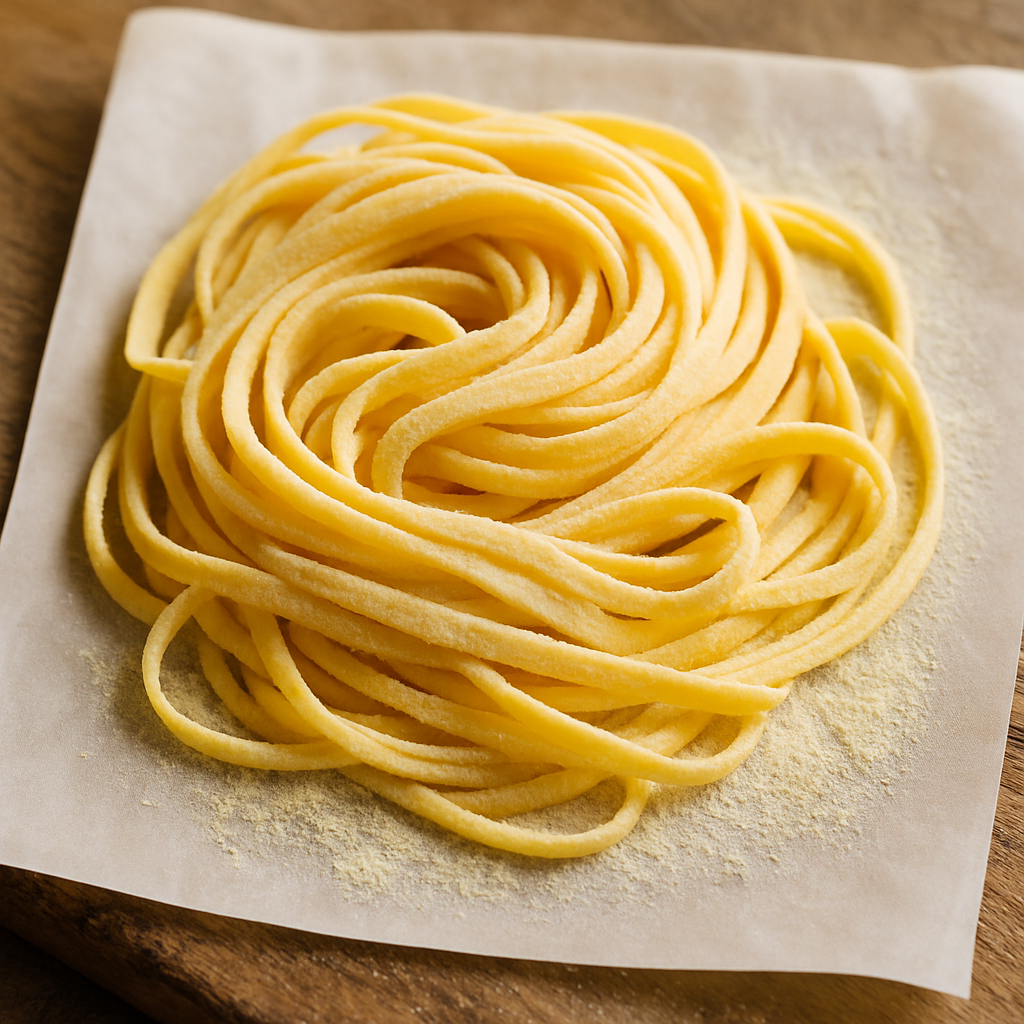
Fresh Semolina Pasta Dough
MEDIUM
35 min
Prep
4
Servings
Classic Italian homemade pasta made from semolina flour, eggs, and water, ready to roll, cut, and cook into tender noodles.
Ingredients
- 300 gram semolina flour
- 3 eggs, large
- 0.25 teaspoon fine sea salt
- 2 tablespoon water
- 0.25 cup semolina flour, for dusting
Steps
- Measure 300g (2 cups) semolina flour and pour it into a large mixing bowl. Create a well in the center of the flour with your hand, making a deep depression large enough to hold the eggs.
- Crack the 3 large eggs directly into the well. Add the 1/4 teaspoon fine sea salt to the eggs.
- Using a fork, gently beat the eggs and salt together in the well, breaking the yolks and incorporating them with the whites.
- Gradually pull semolina flour from the inner walls of the well into the beaten eggs with the fork, mixing slowly. Continue pulling flour in and mixing until a shaggy dough begins to form.
- When the dough becomes too stiff to mix with the fork, use your hands to combine all the flour and egg. If the dough is very dry and not coming together, sprinkle 1-2 tablespoons of water over it gradually while kneading.
- Turn the dough out onto a clean, lightly floured work surface. Begin kneading the dough by pushing it away from you with the heel of your hand, then folding it back over itself. Rotate the dough a quarter turn and repeat.
- Continue kneading for 8-10 minutes until the dough becomes smooth, elastic, and no longer sticky. The dough should feel slightly firmer than bread dough. If it sticks, dust your hands and the surface lightly with semolina flour.
- Shape the kneaded dough into a ball. Wrap it tightly in plastic wrap or cover with an inverted bowl.
- Allow the dough to rest at room temperature for 30 minutes. This relaxes the gluten and makes rolling easier.
- After resting, unwrap the dough. Divide it into 4 equal portions (about 75g each) for easier handling.
- Working with one portion at a time, flatten it slightly into a rectangle. If using a pasta machine, set it to the widest setting and pass the dough through, feeding it lengthwise.
- Fold the flattened dough in half lengthwise and pass it through the widest setting again, feeding the folded edge in first. Repeat this folding and passing 2-3 more times until the dough becomes smooth and is about 1/8 inch thick.
- Gradually move the pasta machine down to narrower settings, passing the dough through each setting once without folding, until you reach the desired thickness (usually the second-to-last setting for fettuccine, thinner for lasagna sheets).
- If rolling by hand, use a rolling pin on a floured surface to stretch the dough to about 1/16 inch thickness, rotating and turning it frequently to maintain an even rectangle.
- Lay the rolled pasta sheet on parchment paper lightly dusted with semolina flour. Repeat the rolling process with the remaining 3 dough portions.
- For fettuccine or pappardelle, loosely roll up each pasta sheet and cut with a sharp knife into strips 1/4 inch (fettuccine) or 1 inch (pappardelle) wide. For lasagna, cut the sheets into 3-4 inch squares. Unroll each cut section and dust generously with semolina flour to prevent sticking.
- Lay the cut pasta in loose nests on parchment paper dusted with semolina flour. Use immediately, or allow to dry for 1-2 hours before storing in an airtight container (fresh pasta will keep 1-2 days in the refrigerator, or up to 1 month frozen).